
Less Really Is More
A three part guide to consuming less

Last Friday, there was a call for Americans to participate in an “economic blackout.”
The effort calcified as people in the United States grappled with the second Trump administration and two unequivocal realities. First, there are a handful of billionaires lining their pockets with our hard-earned money now at the helm of our government. Second, many companies have pulled back their diversity, equity and inclusion programs following Trump’s Executive Order to eliminate DEI from the federal government.
In an effort to push back, people all across the country took to social media to demand an economic blackout on February 28, 2025. The goal: to spend nothing, or at the very least, to spend nothing on large corporate institutions — no Amazon, no Target, no Walmart, no fast food chains, no gas, no credit or debit cards, etc.
While I love this concept, I’d amend it to extend beyond a single day. Of course, it is essential to hold companies accountable when they do things that don’t align with our values. However, this economic blackout only caught on because the vivid display in value shifting — cutting DEI programs, for example — made it easy for Americans to pinpoint these problematic companies. What is more insidious, and often invisible, is just how much stuff these companies produce on a regular basis and how much of it we consume without even thinking twice.
This doesn’t just apply to the United States. We, as human beings, have a global consumption problem. The planet simply cannot maintain the supply to keep up with our demand.
We need to consume less, and we need to start consuming less yesterday. According to the United Nations Sustainable Development Goals, if the population reached 9.8 billion people by 2050, three Earths would be needed to sustain our collective lifestyles. So, yes, single-day strikes are good, but reevaluating our relationship with consumption over the course of a lifetime is even better.
In 2016, I decided to go “zero waste,” and by zero waste I quite literally mean no trash. Now, nearly ten years later, I’m not quite as strict, but I do adhere to a “low waste” lifestyle, consuming less than the average person and wasting as little as possible.
My low waste lifestyle is rooted in the foundation of this post: consume less. So, what can we do? Let’s get into it.
1. Consume Less Energy
Consuming less energy is integral to combatting climate change. Modern-day energy, which is largely produced by burning fossil fuels, is the leading contributor to greenhouse gas emissions, which cause climate change by trapping heat in the atmosphere and warming the planet. I’m talking about energy for our homes and industry like electricity and power, but I’m also talking about energy for transportation, like oil and gas.
In terms of electricity, most electricity is still generated by burning fossil fuels. When we burn this coal, oil and gas they emit Carbon Dioxide and Nitrous Oxide — greenhouse gases that trap heat and contribute to climate change. In 2022, CO2 made up 79.7% of emissions in The United States. While much of this can be contributed to industry, agriculture and production, it is also directly linked to our everyday lifestyles and our use of heating, ventilation, air conditioning, lighting, appliances and plug loads (energy generated when things are plugged in).

In terms of transportation, we rely primarily on fossil fuels to power cars, trucks, ships, trains and planes. Over 94% of fuel for transportation is petroleum based, or, derived from oil and natural gas. Transportation — under the umbrella of energy — is the largest contributor to greenhouse gas emissions.
Now, it’s important to keep in mind that these things are luxuries and privileges that many in the world do not enjoy. For example, in 2023, a United Nations Sustainable Development Goals assessment found that 675 million people still don’t have access to electricity and 2.3 billion don’t have access to clean cooking fuels. Cooking with oil, natural gas and coal contribute substantially to climate change.
However, many of us — and by many, I do mean billions — rely on electricity and transportation to exist in modern-day society.
The solution here is for those of us already on the grid, to live on it more sustainably, and to get those who are not on the grid, on it sustainably. This “don’t let perfect get in the way of good” mentality can be used for transportation: if you live in a place with public transportation, use it. If you can, drive less. If you can, fly less. If you can — and I know you can — think twice before you click purchase on that Amazon Prime next-day delivery.
Next, no matter where you live, there are options to reduce your energy consumption. Of course, smaller spaces require less energy overall. We can all strive to live in spaces that accommodate our needs and avoid contributing to our culture of excess. If you own your space and have the means, it’s worth considering investing in technologies like smart thermostats and energy efficient appliances that can help reduce energy consumption and maximize efficiency. If you rent your space, you may not have the ability to think quite as big, but you can take smaller steps that are still quite mighty. Be mindful of the season and how natural light impacts the temperature of your space — e.g. shades down in the summer and up in the winter, use power strips to conserve energy, advocate for energy efficient appliances and smart meters in your building, use air conditioning and heat sparingly and only when necessary.
Depending on where you live, you might have the opportunity to source your energy via renewables so you can consume less fossil fuels. Even if you use a conventional energy supplier, there are a handful of third-party renewable companies who work with traditional suppliers to source clean energy from wind and solar, primarily. For example, I live in New York City where two energy monopolies rule the five boroughs. Everybody gets their energy from either Con Edison or National Grid. However, I’m able to source my energy responsibly through a third-party company called Green Mountain Energy. Green Mountain Energy works with Con Edison to provide them with clean energy from their 67 wind farms and 8 solar farms. For what it’s worth, you can find Green Mountain Energy in Illinois, Maryland, Massachusetts, New Jersey, New York, Pennsylvania and Texas. Here’s a real-time look at how Green Mountain Energy helps me to reduce my reliance on fossil fuels, support clean energy programs and minimize my CO2 footprint:
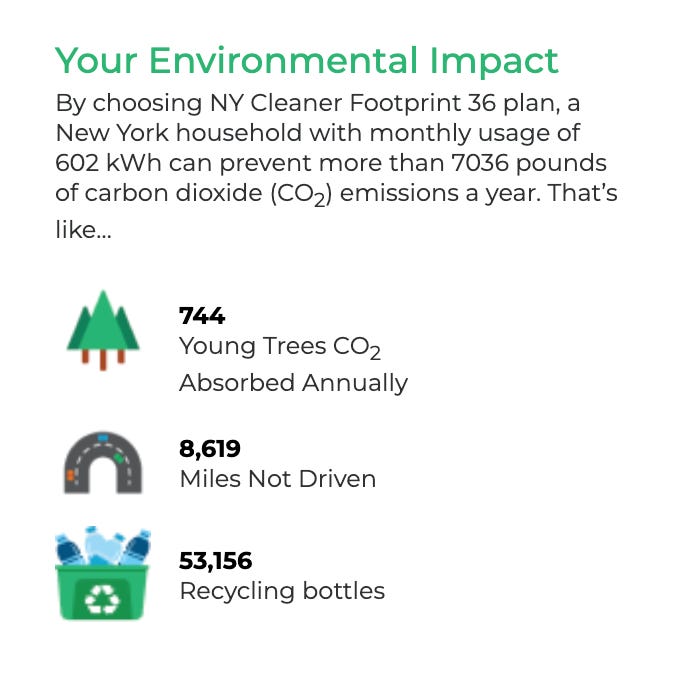
Finally, in an effort to consume fewer fossil fuels, we need to advocate for a renewable energy transition. This means speaking up and voting with your money whenever and wherever possible. It might feel silly to use a third-party company to source renewables when it’s difficult to track the efficacy, but every time somebody signs up for a program like that, they’re telling their energy provider, “This matters to me.” In addition to these personal changes, we have the ability to put people into positions of power who can make institutional changes. Collect signatures for, phone bank for and vote for public servants who support transitioning away from fossil fuels and towards renewable, clean energies. Challenge, question and be skeptical of those who do not.
2. Consume Less Stuff
We love stuff. I love stuff, you love stuff — look, we all love stuff. However, we need to consume less stuff.
We are consuming more stuff than ever before and all of that stuff is derived from natural resources. Our planet simply can’t keep up. Between 2000 and 2019, the amount of raw materials used to produce stuff increased by 66%. Also problematic is how much more high-income countries consume than low-income countries. The material footprint of high-income countries is ten times the level of low-income countries. That doesn’t stop high-income countries — like The United States — from exporting their wasted material goods to low-income countries, who then bear the environmental burden of disposing of them.
When I say “material goods” and “stuff” I’m talking about it all. I mean clothes, furniture, electronics, toys, trinkets, home goods, plastics, etc. It isn’t just the fact that what we buy requires resources to be produced, but it’s the fact that once we’re done with it, we just throw it away. Here’s the thing: out of sight is not out of mind.
When we throw away our things, they do not disappear. They wind up in landfills, which can harm both people and the planet in different ways. Landfills contribute to air pollution, soil pollution, water pollution and have been linked to cancer, asthma, birth defects and other illnesses in human beings.
From the top-down, there are accessible solutions that can be implemented to make a dent in the environmental impact of our stuff. Governments globally need to set targets to reduce waste, invest in circular production methods and promote sustainable production and materials.
As individuals, we also have to take responsibility for the stuff we consume and subsequently get rid of. We have to consume less. Buy less stuff, buy second hand stuff, repair what you already own that is broken, buy stuff that is produced sustainably or in a closed loop system. For every single thing you buy, take a day and think: do I really need this?
Down the line, I’ll be working on lists of sustainable companies and swaps for paid subscribers, but for now: buy less, consume less and think twice about everything you purchase.
3. Consume Less Food
Okay, I don’t actually mean consume less food. In fact, there’s an argument to be made that we need to be consuming more food with higher nutrient concentration. That’s a different post for a different day.
However, there is no denying that contemporary agriculture is a leading contributor to climate change. In fact, in 2022, agriculture contributed to 10% of total United States greenhouse gas emissions. Globally, agriculture is the leading cause of pollution in many countries.
Agriculture can harm the environment and contribute to climate change in many different ways. The use of pesticides, herbicides, chemical fertilizers and the practice of monocropping (planting one crop year after year) degrades the land and can pollute the soil and water. Clearing forests for agriculture and livestock contributes to greenhouse gas emissions. Cutting down trees also leads to losses in biodiversity and Carbon sinks, since trees suck up excess CO2 from the atmosphere. Concentrated animal feeding operations, or, CAFOs, house hundreds of animals and produce pollutants that destroy local soil, waterways and cause air pollution. We also import, export and ship food hundreds of miles continuing the cycle of emitting greenhouse gases and contributing to climate change.
Just like with consuming less energy and consuming less stuff, there are solutions from the top-down that our governments, public servants and institutions need to advocate for and implement. We need to implement regenerative agriculture practices that protect the land, soil and air. We need to let animals roam and graze on the grasses they were meant to eat, as opposed to pumping them full of corn to fatten them up. We need to relax with the plastic packaging. We need to relinquish our obsession with non-native foods being available at any given time in high-income countries.
So, what can we do? Well, what we eat is one of the most tangible ways we can vote with our money and take a stand. Try to buy seasonally produced food from local vendors. Shop at your local farmer’s market. Get to know the people who harvest your food. Buy things that have been farmed using organic or regenerative agricultural practices. Shop small. Avoid ultra-processed foods. Try to buy organic food.
Essentially, eat less food that has been produced unsustainably and support local farmers who are producing their food sustainably. I’ll be providing tips, tricks and recipes for both unpaid + paid subscribers down the line. For now, here is a great sustainable food purchasing guide.
Whether it’s consuming less energy, consuming less stuff or consuming less unsustainable food — we can all be doing just a little bit more. Think twice, vote with your money and let me know your questions in the comments.
Next week: wasting less — why it matters and how to do it.
Stay tuned,
Meg-of-all-trades